High information density
Surface the right market and position information without forcing traders to hunt across the experience.
Simplifying advanced options workflows while preserving the data and control active traders rely on.
Options trading is information-dense by nature. The challenge was not to remove complexity indiscriminately, but to make sophisticated workflows easier to understand and operate while preserving the data, flexibility and control experienced traders rely on.
Surface the right market and position information without forcing traders to hunt across the experience.
Make strategies with several legs easier to construct, review and modify.
Help traders understand risk, strategy structure and order details before committing.
Research with options traders surfaced difficulty executing multi-leg strategies, navigating multiple screens, customizing options-chain data, and getting enough real-time information to make fast decisions.
Advanced strategies such as spreads and straddles took too many steps to set up and review.
Managing trades across multiple screens and tabs slowed users down.
Traders could not easily customize table data around the way they trade.
I reviewed Schwab’s existing options experience, conducted user interviews, analyzed competing platforms such as thinkorswim and E*TRADE, and tested the current experience to understand where speed, clarity and control were breaking down for active traders.
Multi-leg strategies required too many steps, while navigating across screens slowed traders down.
thinkorswim and E*TRADE provided stronger strategy-building, charting and options-chain experiences.
Complex order entry and buried advanced features made it harder to act quickly.
Early low-fidelity concepts helped explore how traders could scan market data, adjust strategies and stay in context without moving across multiple screens. The core interaction model became the foundation for the final experience.
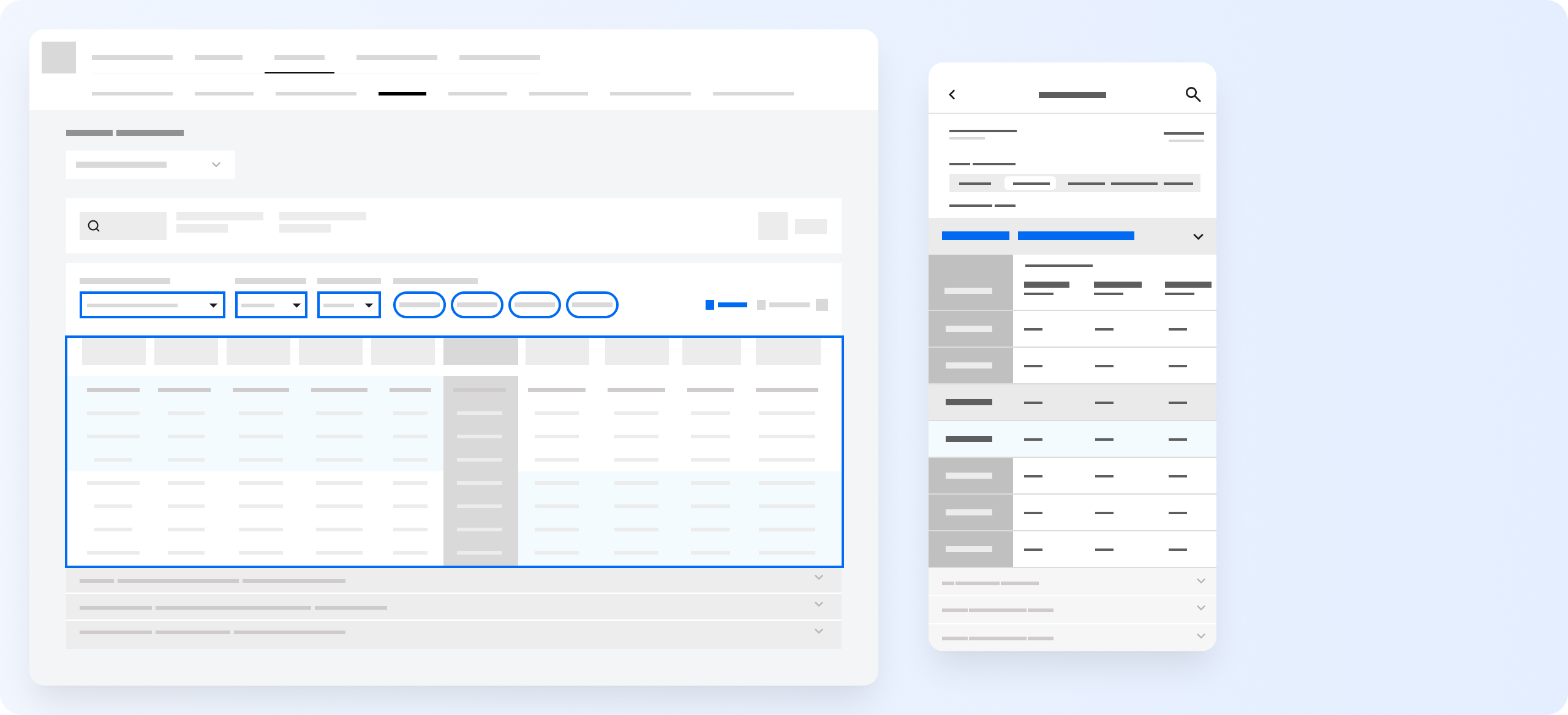
Research translated into three principles that shaped the redesign: improve scanability, preserve context, and give experienced traders more control without stripping away advanced capability.
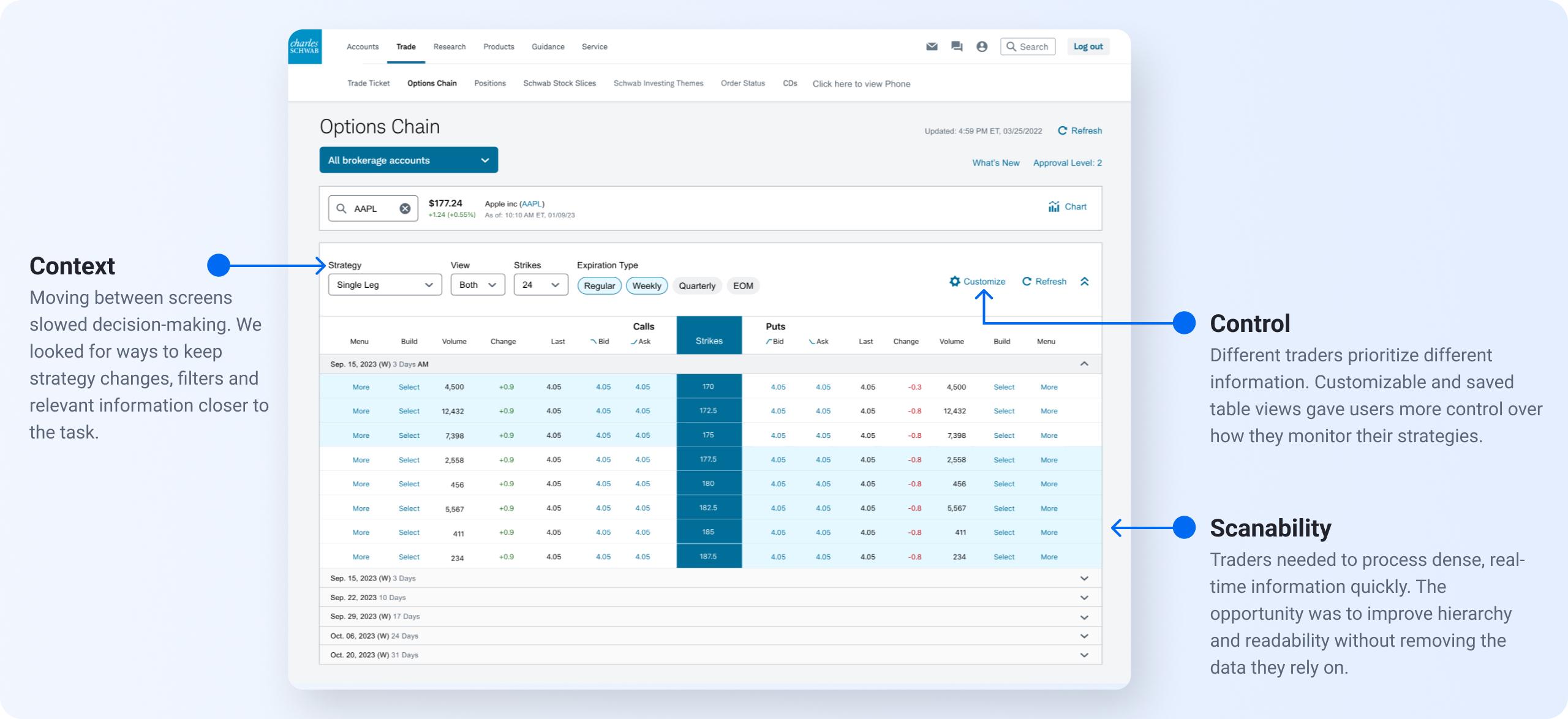
During usability testing, users responded positively to the simplified experience and highlighted the real-time risk visualization as particularly useful for informed decision-making.
former TD Ameritrade traders reported a smooth transition
increase in options trading volume attributed to enhanced tools and UX
improvement in trader confidence and satisfaction
I also supported the Open Positions feature to help that team keep its project on track, contributing beyond my primary options-trading work.
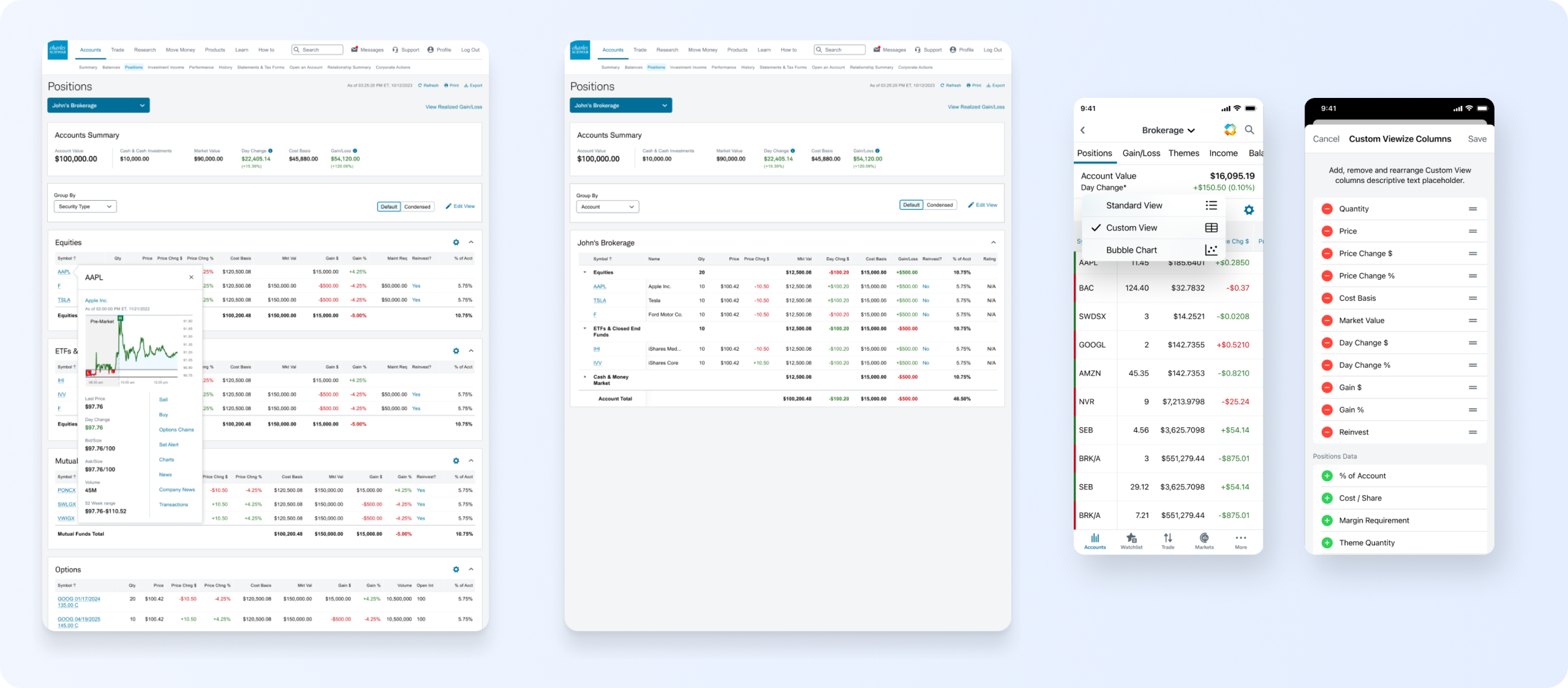
The design direction focused on reducing unnecessary steps, improving scanability, and making risk and strategy information easier to interpret. The objective was to help users move faster because the experience was clearer, and not because important information had been removed.
Keep advanced functionality available for users who need it.
Use clearer hierarchy and feedback so users understand what they are building and changing.
Support scanning and comparison across contracts, legs, pricing and risk information.